Polda West Java Food Security Program Becomes National Role Model, Polri Partners with Himbara to Formulate Program Development

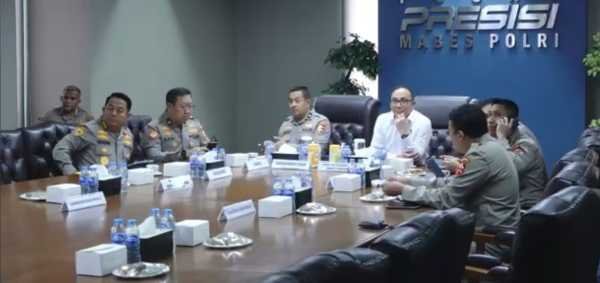
Strategic Coordination Meeting (Rakor) on Food Security held at the Precision Command Post of the Polri Headquarters, South Jakarta.
progresifjaya.co.id, JAKARTA – Polri Headquarters has decided that the technical scheme for the Polda West Java Food Security Program will serve as a national role model for implementing an agricultural ecosystem, particularly for the provision of corn for animal feed. This decision was announced during the Strategic Coordination Meeting (Rakor) on Food Security held at the Polri Headquarters Precision Command Post, South Jakarta, on Friday, February 6, 2026.
The coordination meeting was led by the Head of the Polri’s Food Security Task Force, Brigjen Pol Langgeng Purnomo, who is also the Deputy Head of the Polri Food Security Task Force Command Post. Also present at the coordination meeting were the Ministry of Agriculture, the State Logistics Agency (Bulog), the Supreme Audit Agency (BPK), the Animal Feed Manufacturers Association, and the Association of State-Owned Banks (Himbara). Meanwhile, all regional police task forces across Indonesia participated in the coordination meeting online.
Brigjen Pol Langgeng Purnomo explained in a coordination meeting that the decision was based on the results of the previous year’s performance evaluation, which demonstrated Indonesia’s success in reducing imports of corn for animal feed.
Based on the analysis and evaluation (Anev) of last year’s performance, the Food Security Task Force has also taken steps to strengthen consolidation and collaboration by holding coordination meetings with relevant parties. These strengthening efforts are expected to have a positive impact on the smooth implementation of the prepared 2026 work strategy.
“One of the strategies formulated for 2026 is using West Java as a barometer. The Polda West Java have proven the success of the Food Security Program’s technical scheme by using a mentoring model as its implementation. The Nagreg and Ciamis regions are the testaments to the success of this scheme,” Brigjen Pol Langgeng explained specifically.
The mentoring model he mentioned as the technical implementation of the Food Security Program is intended to be a smart way to act as a bridge between farmer groups and business capital providers.
“The classic obstacle for farmers’ businesses is capital. Well, this is what the Polda West Java are solving as a technical part of the program’s implementation. To become an effective bridge for farmers to solve problems that hinder the movement of the wheels of the business. So good. That’s a smart way to think,” said Brigjen Pol Langgeng praising him.
Based on the successful implementation of the established program, Brigjen Pol Langgeng continued, the Polri then formulated a development plan by collaborating with Himbara (Indonesian Association of State-Owned Enterprises). A consolidation agreement was reached, with the Polri once again acting as a bridge to facilitate access to People’s Business Credit (KUR) for farmer groups.
And as stated by BRI Senior Vice President Danang Andi Wijanarko, Brigjen Pol Langgeng continued, BRI has prepared a financing ceiling of Rp180 trillion for Micro KUR in the agricultural sector in 2026, including for the corn ecosystem, which is the main axis of the Polda West Java Food Security Program.
Proportional Emphasis Scheme
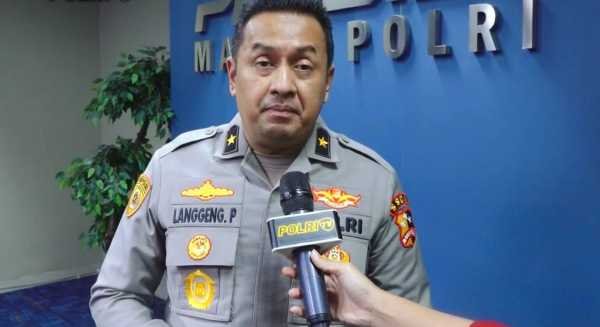
Head of the Polri’s Food Security Task Force, Brigjen Pol Langgeng Purnomo, who is also the Deputy Command Post of the Polri’s Food Security Task Force.
The implementation of the Polda West JavaFood Security Program, which has been recognized as successful, was also carefully planned with a proportional emphasis scheme that serves as the framework for the program.
For example, while the discussion of the successful program implementation at the beginning of the narrative focused on the upstream area, we now shift the discussion to the downstream area. In this area, the success of implementation can be seen in price stability and the ineffectiveness of price manipulation by middlemen against farmers. Harvest absorption is guaranteed at a profitable price thanks to the well-maintained quality of the bohay (corn) with the State Logistics Agency (Bulog).
Essentially, farmers in downstream areas are guaranteed to remain secure because the program’s emphasis scheme has been designed proportionally to create a strong framework to withstand the burden of expectations from the Polda West Java Food Security Program.
Furthermore, the Bulog Internal Official Letter has been issued as of January 12, 2026, and can serve as a reference. The target for government reserve corn procurement has been set at 1 million tons with a purchase price of Rp 6.400 per kilogram.
“Our focus in the downstream sector is to maintain prices at the farmer level at least in line with the Government Purchase Price (HPP). In West Java and South Kalimantan, this collaboration has already driven purchases to Rp6.400 per kilogram,” he explained further.
Doping with 4 Patented Formulas
The Head of Human Resources of the Polda West Java, Kombes Pol Fadly Samad, separately provided detailed information about the “engine” of the Polda West Java Food Security Program, which has now become a national role model.
He explained, that a stable and secure national food security condition is the desired goal. Therefore, a patented formula with super-speed is needed to boost the speed and smoothness of the program.
“To achieve this speed and smoothness, we have developed four formulas as the doping medium. The first is a CSR formula and interest-free financing, a program called ‘Keroyok Bareng Rame-rame’ (Joining Together Together). The concept of this formula is that one Polsek manages two hectares of land,” explained Kombes Pol Fadly in detail.
Next is a loan formula through Primkopol (Polri Cooperatives) with a profit-sharing system, or a very low interest rate of 1.5%. This aid formula is not in the form of cash, but rather tangible agricultural necessities such as seeds, fertilizers, medicines, and agricultural machinery (alsintan).
The third formula, formulated as a driver to facilitate the optimal implementation of the KUR program at the farmer level, is the final formula, which utilizes idle land owned by PTPN (State-Owned Enterprises) and Perhutani (Perhutani) using a loan-benefit scenario, managed jointly with farmer groups. (Bembo)