At the Launch of APIK at UI, the Kabaharkam Polri Highlights the Strengthening of the “Polisi Bersama Masyarakat” Concept


Head of the Security Maintenance Agency (Kabaharkam) of the Polri, Komjen Pol Herry Heryawan.
progresifjaya.co.id, JAKARTA – The Head of the Polri Security Maintenance Agency (Kabaharkam), Komjen Pol Herry Heryawan, emphasized that the success of the police can no longer be measured solely by the number of law enforcement actions taken. Instead, it should be gauged by the level of security, justice, and public trust felt by the community.
According to him, the policing paradigm must continue to shift—moving away from an approach oriented toward control and enforcement, and toward one focused on prevention, problem-solving, and partnership with the public.
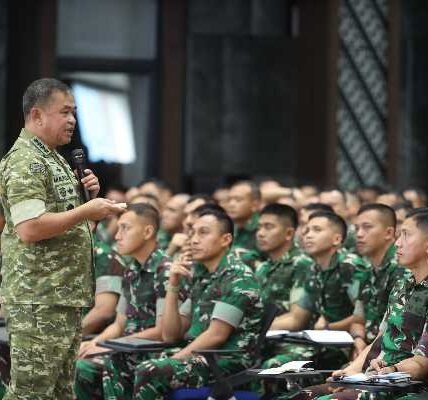
Komjen Pol Herry conveyed these remarks while representing the Kapolri, Jenderal Pol Suyudi Ario Seto, at the launch of the Association of Higher Education Institutions for Police Studies (APIK) at the University of Indonesia, Salemba, Jakarta, on Wednesday, October 21, 2026.
He stated, that the measure of police success is not the volume of law enforcement activities conducted, but rather the extent of the benefits provided to the community and the level of public trust earned.
He explained, that this paradigm shift is part of strengthening the “Polisi Bersama Masyarakat” concept, which views citizens not merely as objects of security measures, but as partners in creating a secure environment.
Under this approach, the police are not present only when a law is broken; their presence should also serve to prevent issues, foster social relationships, and provide solutions to the various challenges faced by the community.
“Law enforcement remains in place, but it is situated within a broader framework—one of prevention and partnership,” said Komjen Pol Herry.
He stressed, that security is no longer defined merely as the absence of disturbances. Rather, security must foster a social order that allows people to live their lives and carry out their activities safely and with dignity, while ensuring their rights are protected.
Therefore, the police must develop a more humanistic, democratic, and sustainable approach, placing the interests of the community at the core of their duties. According to him, security cannot be built by the police alone. Technological advancements, social changes, inequality, and even environmental crises have created increasingly complex security challenges.
This situation demands the involvement of the government, academia, the business sector, local communities, and civil society in building an interconnected security ecosystem.
Within this ecosystem, the police serve as protectors, connectors, and facilitators, as well as enforcers of the law. Meanwhile, the public plays a vital role in early detection, the prevention of security disturbances, and the resolution of social issues.
“Early detection and problem-solving are carried out in partnership with the community, while remaining firmly grounded in the rule of law, respect for human rights, and accountability in the exercise of authority,” he stated.
Furthermore, Komjen Pol Herry noted, that the transformation of the police force requires support from the academic community—including the courage to critically and objectively evaluate police practices.
He emphasized, that the development of police science should not be directed solely toward enhancing the institution’s capacity to control crime. Rather, police science must also strengthen democracy, protect human dignity, and build both legitimacy and public trust.
“A robust field of study should make its subject—in this case, the police—more accountable to the public, not more insulated from criticism,” he asserted.
On this occasion, Komjen Pol Herry also outlined five agendas for strengthening the “Polisi Bersama Masyarakat” concept: reorienting police education, developing evidence-based research, transforming the police presence—both physically and digitally—updating indicators of success, and utilizing the public’s experiences as a basis for institutional evaluation.
According to him, future police education must produce personnel who possess not only professional competence but also ethical maturity, social empathy, and the skills to resolve community issues.
Moreover, the indicators for police success must be broadened to include the quality of service, effective problem-solving, the public’s sense of security, procedural justice, and the level of public trust.
Komjen Pol Herry also conveyed the Kapolri’s appreciation for the establishment of APIK, which serves as a collaborative platform for academics and practitioners to advance police science in Indonesia. The launch of APIK—held as part of the 1st Anniversary of the Graduate School of Sustainable Development at the University of Indonesia—is expected to strengthen the university’s contribution toward producing research and policy recommendations that are relevant to the needs of society.
According to Komjen Pol Herry, the Kapolri hopes, that APIK will evolve into an inclusive academic organization—one that is open to criticism and capable of bridging the gap between academic knowledge and police practice.
Through this collaboration, the development of police science is expected to extend beyond mere academic discourse, ultimately driving tangible changes in how the police are present, how they carry out their duties, and how they build relationships with the public.
“The success of the police’s presence is no longer measured solely by enforcement actions, but also by the sense of security, justice, and trust experienced by the community,” he concluded. (Bembo)