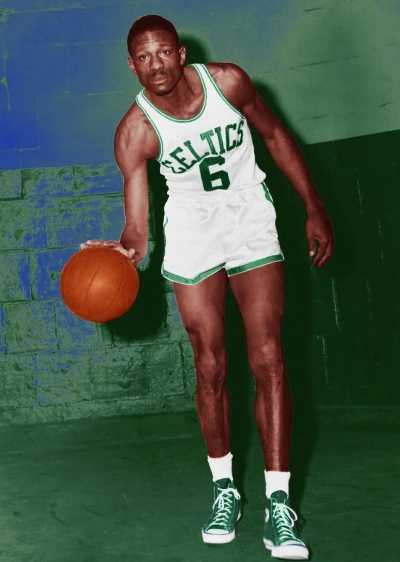
Legendary Boston Celtics center Bill Russell.
progresifjaya.co.id, JAKARTA – Boston Celtics Center, William Felton Russell, aka Bill Russell, was born on February 12, 1934, in Monroe, Louisiana. The 2.08 m (6 ft 7 in) tall man was the backbone of the Boston Celtics dynasty of the 1960s, which won 11 NBA championships. Wearing the number 6 jersey, Bill Russell was renowned for his exceptional shot-blocking abilities and revolutionized NBA defense.
In 963 games over 13 seasons in the NBA, Bill Russell averaged 22,5 rebounds per game and 21,620 rebounds throughout his 13-season career, from 1956 to 1969 with the Boston Celtics. More specifically, he once grabbed 51 rebounds in one game, 49 rebounds in two other games, and over 1.000 rebounds in twelve consecutive seasons. His defense was impressive, wasn’t it?
The author’s story about Bill Russell begins with his time at McClymonds High School in Oakland. At that time, young Bill Russell was still an awkward and unremarkable center on the McClymonds basketball team. However, due to his large size, he earned a hockey scholarship to play at the University of San Francisco, where he flourished.
He teamed with guard K.C. Jones to lead the University of San Francisco Dons to 56 consecutive wins and the NCAA championship in 1955 and 1956 (although K.C. Jones missed four games in the 1956 tournament due to expired eligibility). In 1955, Bill Russell was honored by being named the NCAA Tournament’s Most Outstanding Player.
Bill Russell averaged 20,7 points and 20,3 rebounds during his three-year career with the university. By his senior season, he had blossomed and become a dominant force capable of controlling the game on the defensive end.
As the 1956 NBA Draft approached, Boston Celtics coach and general manager Red Auerbach expressed a strong desire to add Bill Russell to his roster. Auerbach had built a high-scoring offensive machine around guards Bob Cousy and Bill Sharman and undersized center Ed Macauley. However, he hadn’t been able to muster the defense and rebounding needed to transform the Boston Celtics into a championship-caliber team. Auerbach felt Russell was the missing piece.
However, due to their second-place finish the previous year, the Boston Celtics would have acquired Russell too late in the draft. And because Auerbach wanted to use the territorial pick to acquire Holy Cross star Tom Heinsohn, the Boston Celtics would have forfeited their first-round pick entirely. Auerbach began considering a trade, ultimately settling for the St. Louis Hawks, thus securing the second overall pick in the draft.
The first pick went to the Rochester Royals, but the team already had a talented young player in Maurice Stokes. Auerbach also knew that Royals owner Les Harrison wouldn’t pay Bill Russell the $25.000 signing bonus he was asking for. Rochester ultimately chose guard Sihugo Green, who played nine seasons in the NBA with five different teams (including, ironically, the Boston Celtics in 1965-1966).
St. Louis owner Ben Kerner was then willing to negotiate a trade, and the key player was Macauley. The 6-foot-8 center was already a six-time All-Star and a local hero in St. Louis, where he grew up and later starred at St. Louis University.
Auerbach could have let Macauley go if he had Bill Russell. But it wasn’t until Boston agreed to add rookie Cliff Hagan to the team that Ben Kerner agreed to the trade. The deal led the Atlanta Hawks to a championship in 1958, but also ushered in a dynasty for the Boston Celtics.
In the same draft, the Boston Celtics added Heinsohn, who would later become the NBA Rookie of the Year for the 1956-1957 season, and K.C. Jones, Bill Russell’s college teammate, who would also become a key player for the Boston Celtics.
Joined in 1956
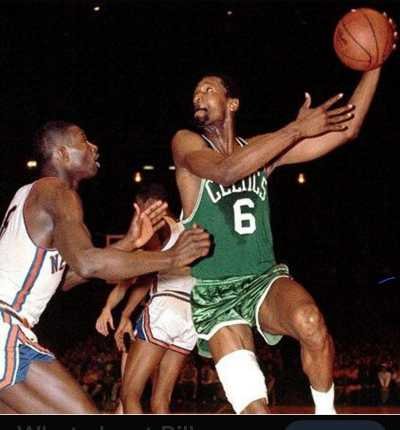
Bill Russell in action on the court as a Boston Celtics player.
Bill Russell joined the Boston Celtics in December 1956. He had previously played for the U.S. Olympic basketball team that won the gold medal at the Melbourne Olympics in November 1956.
The Boston Celtics started the season with a 13-3 record, and when Bill Russell arrived, he adapted quickly. Playing in 48 games, he grabbed 19,6 rebounds per game, a league-best average, and scored 14,7 points per game.
Boston’s starting five of Russell, Heinsohn, Cousy, Sharman, and Jim Loscutoff were a powerful unit. They posted the best regular season record in the NBA in 1956-1957, cruised through the playoffs, and were heavy favorites in the finals against Bob Pettit’s St. Louis Hawks. The two teams traded wins until the series reached a dramatic Game 7 in Boston.
Heinsohn scored 37 points for the Boston Celtics, but the team couldn’t get a big lead. A last-second basket by the Hawks sent the game into overtime and into a second overtime. The Boston Celtics ultimately won 125-123 to claim their first NBA championship.
In just a few seasons, Bill Russell had added a new element to the Boston Celtics and professional basketball. For the previous few years, the Boston Celtics had been an unstoppable offensive machine led by 20-pointers Cousy and Sharman, both future Hall of Famers.
But the Boston Celtics lacked the rebounding and defense to win it all. With the arrival of Bill Russell, who brought a new level of defensive prowess, intimidating opponents with his shot-blocking, the Boston Celtics proved that it didn’t take a single point-scorer to dominate.
Spurred on by their championship victory, the Boston Celtics won 14 straight games to start the 1957-1958 season and continued to surge. In his first full season in the NBA, Bill Russell took control and led the league with 22,7 rebounds per game. Early in the season against the Philadelphia Warriors, he set an NBA record for rebounds in a single half with 32 rebounds and ultimately collected 49 rebounds in the game.
His rebounding prowess stemmed from his positioning, anticipating where shots would bounce off the rim and quickly moving toward the ball. His game was as analytical and mental as it was physical.
The Boston Celtics posted the league’s best regular season record that year, finishing atop the Eastern Division with a 49-23 record. The Celtics then returned to the NBA Finals for a rematch against the St. Louis Hawks, who had won the Western Conference with a 41-31 record. The teams split the first two games at Boston Garden, but in Game 3, Bill Russell suffered an ankle injury. The Celtics’ fortunes declined, with Russell ineffective the rest of the way. St. Louis won two of the next three games to win the series.
Bill Russell again became the NBA’s rebounding leader in the 1958-1959 season, averaging 23,0 rebounds per game, the first of seven consecutive seasons in which he averaged at least 23 rebounds. Russell was also known for giving his all in critical moments, both during a game and during a season.
He typically increased his rebounding numbers during the playoffs and in the postseason. In the 1959 season, he averaged 27,7 rebounds per game.
Dominating the Game on Both Ends of the Court

Bill Russell as a player and coach for the Boston Celtics.
The Boston Celtics reached the NBA Finals for the third consecutive season and reclaimed the championship with a four-game upset victory over the Minneapolis Lakers. Bill Russell set a Finals record with 29,5 rebounds per game in the series. The Boston Celtics’ 1959 championship began an unprecedented and unmatched streak of eight consecutive NBA championships.
Russell’s greatest rival, Wilt Chamberlain, entered the NBA and joined the Philadelphia Warriors for the 1959-1960 season, sparking a decade-long rivalry. The debate over who was the greater player would rage on for much longer. Wilt Chamberlain produced incredible numbers during the period in which the two faced off, but Bill Russell helped the Boston Celtics hang nine NBA championship banners at the Garden in his first 10 seasons.
As Celtics player Don Nelson told the Boston Herald, “There are two types of superstars. One makes himself look great at the expense of everyone else on the court. But there’s another type who makes everyone around him look better than they really are, and that’s the Bill Russell type.”
Wilt Chamberlain led the league in points (37,6 points per game) in his first season, and he usurped Bill Russell’s rebounding record, 27,0 rebounds to Russell’s 24,0. However, the Boston Celtics center had one remarkable game when he grabbed 51 rebounds against the Syracuse Nationals in the 1959-1960 season. That figure ranks as the second-best rebounding effort in NBA history, behind Chamberlain’s 55 rebounds against the Boston Celtics the following season.
What became clear, both during the 1959-1960 season and over the next few years, was that basketball is a team game. As Bill Russell later wrote: “To me, one of the most beautiful things you can see is a group of men coordinating their efforts toward a common goal.
Alternately subduing and asserting themselves to achieve real teamwork in action. I tried to do that. We all tried to do that on the Celtics. I think we succeeded.”
Wilt Chamberlain was great, but the Boston Celtics were greater. They improved their regular season record to 59-16 in 1959-1960, even going on a 17-game winning streak. They eliminated Chamberlain and the Warriors in the division finals, then met St. Louis again in the 1960 NBA Finals. Bill Russell upped his game in the title series, setting an NBA Finals record with 40 rebounds in Game 2 (surpassed by Chamberlain’s 41 rebounds in 1967).
The St. Louis Hawks extended the series to seven games, but Russell dominated Game 7, contributing 22 points and 35 rebounds as the Boston Celtics won 122-103 and clinched their second consecutive championship.
Bill Russell changed the way the NBA viewed defense. The league seemed to be still in the era of offensive dominance, with Chamberlain at the helm. Even the defensively-oriented Boston Celtics averaged 124,5 points.
Bill Russell’s impact on the game can’t really be tracked through NBA statistics. Blocked shots weren’t an official statistic until the 1973-1974 season. The league only recorded total rebounds, without distinguishing between offensive and defensive rebounds.
Bill Russell then revolutionized the game in ways that were clearly understood, though not quantified. His ability to leave his guard and shift to block an opponent’s dribbling to the basket was astonishing. He was unmatched at gliding across the defense like a large bird to block and redirect shots.
Other Boston Celtics defenders began directing their players toward Bill Russell and became more aggressive in their perimeter defense, knowing that Russell was lurking behind them.
This was all a mind game with opposing shooters near the basket and had a disruptive effect because they felt Russell’s intimidating presence. Furthermore, other centers began emulating Russell’s defensive style, and while they may not have been as great, it changed the way the game was played.
Interestingly, Russell’s style of play also invigorated the Boston Celtics’ offense. Many of the Celtics’ points came from Russell grabbing defensive rebounds and quickly passing to Cousy, who would initiate the Celtics’ famous and deadly counterattack.
A dynasty was indeed formed under Auerbach’s leadership, and “Boston Celtics” and “NBA champions” became practically synonymous as the decade progressed. The team boasted many talented players, but the enduring image remained that of Bill Russell. With his head slightly bent, his eyes scanning the court, and his long left arm extended to deflect shots.
The Boston Celtics won another championship in the 1960-1961 season, and Bill Russell was named the NBA Most Valuable Player (MVP), the first of three consecutive MVP awards.
Preparing for Retirement

Bill Russell as a coach.
The following season, 1961-1962, the Boston Celtics added another future Hall of Famer, John Havlicek, in the 1962 NBA Draft and lost Cousy to retirement at the end of the 1962-1963 season. In what became an annual routine, the Boston Celtics won their fifth consecutive NBA title in 1963, and Bill Russell earned his third consecutive MVP award.
The legendary player later called the 1963-1964 Boston Celtics the best team of his era. Although only competent offensively, he felt it was the best defensive unit ever assembled. Bill Russell once again led the league in rebounding, with an all-time high of 24,7 rebounds per game.
The Boston Celtics, on a relentless run, defeated the San Francisco Warriors in the Finals in five games, capturing their sixth consecutive NBA championship. Something no team in the major leagues had ever achieved before in any sport.
It was an era of sustained achievement, for both Bill Russell and the team. Russell again became the NBA’s rebounding leader in the 1964-1965 season, collecting 24,1 rebounds per game, including a 49-rebound game against the Detroit Pistons that season. He also ranked fifth in the league in assists with 5,3 per game.
The most dramatic moment of the season came in Game 7 of the Eastern Division finals, when the Boston Celtics were up 110-109 with five seconds left against Wilt Chamberlain and the Philadelphia 76ers. Bill Russell’s inbounds shot hit the basket wire, giving the Sixers the ball with no time left on the game clock. Philadelphia’s Hal Greer threw the ball to Chet Walker, but Havlicek stole the ball to seal the victory.
That moment, as commentated by famed Celtics announcer Johnny Most, is an NBA treasure. In his raspy voice, Most shouted, “Havlicek stole the ball. Give the ball to Sam Jones. Havlicek stole the ball! It’s over! Johnny Havlicek stole the ball!”
The NBA Finals against the Los Angeles Lakers almost felt anticlimactic, as the Boston Celtics clinched the championship in five games. For his performance that season, Bill Russell won his fifth and final NBA Most Valuable Player (MVP) award.
After winning another NBA championship in the 1965-1966 season, Auerbach retired, and Bill Russell took over as player-coach the following season, becoming the league’s first African-American coach.

Bill Russell in his later years after retiring from basketball.
He led the Boston Celtics to a 60-21 regular season record, but their championship streak ended when they lost to the formidable Philadelphia 76ers in the Eastern Division Finals. The Sixers, who had a 68-13 regular season record and were considered one of the best teams in league history, defeated the Boston Celtics in five games to advance to the NBA Finals.
After a year off, the Boston Celtics returned to their best form in the 1967-1968 season, winning another championship under Bill Russell. In the Eastern Division Finals, the team rallied from a two-game deficit to force a seventh game against Chamberlain and the 76ers. The Boston Celtics led 97-95 with 34 seconds remaining when Bill Russell took control.
He made a free throw, blocked a Walker shot, grabbed a rebound from a Greer miss, and passed the ball to Jones, who scored the final points in a 100-96 victory. The Boston Celtics then defeated Los Angeles in six games in the NBA Finals.
The 1968-1969 season was even more satisfying. The aging Boston Celtics narrowly missed the playoffs with a 48-34 record, then rallied in the postseason. In Bill Russell’s third year as player-coach, the Boston Celtics again became NBA champions, defeating the Lakers, who had acquired Chamberlain, in a seven-game championship battle.
The great leader of the Boston Celtics soon retired after leading the team to 11 championships in 13 years. Bill Russell had 21.620 career rebounds, second only to Wilt Chamberlain’s 23.924.
In 1970, Bill Russell was selected to the NBA All-Time Team for its 25th anniversary. In 1974, Russell was also elected into the Naismith Memorial Basketball Hall of Fame.
A year earlier, in 1973, Bill Russell reappeared as head coach and general manager of the Seattle SuperSonics. He took over a team that had won just 26 games the previous year and led it to a winning streak, posting 36 wins the following season and then compiling a 43-39 record to secure a playoff berth in the 1974-1975 season.
However, Russell grew frustrated with the players’ reluctance to accept his team’s philosophy. Some argued that the problem lay with Russell himself; he was said to be aloof, irascible, and unable to accept anything other than Boston Celtics tradition. His enthusiasm for the job faded after his fourth season in 1976-1977, and he left.
NBA Retires Number 6

Announcement of the death of legendary Boston Celtics center Bill Russell on July 31, 2022, at the age of 88.
Ironically, Lenny Wilkens led Seattle to a championship two years later, implementing the same team philosophy that Russell had unsuccessfully tried to instill in his players. A decade after leaving Seattle, Bill Russell tried his hand at coaching again, replacing Jerry Reynolds as coach of the Sacramento Kings early in the 1987-1988 season. The team stumbled to a 17-41 record, and Russell left midway through the season.
While the arrival of Michael Jordan at the end of the decade may have reignited the debate about who the game’s greatest player truly was, it remains undeniable that Bill Russell radically changed the way people think about how basketball games are won.
In 2009, during NBA All-Star weekend in Phoenix, NBA commissioner David Stern announced that the NBA Finals MVP Award would be named after Bill Russell. In 2010, Russell was awarded the Presidential Medal of Freedom. Then, in 2017, Russell was announced as the inaugural recipient of the NBA Lifetime Achievement Award.
In 2020, Russell was among three winners of the Mannie Jackson Humanitarian Spirit Award – Basketball for his decades-long commitment to social justice.
The NBA officially retired Boston Celtics legend Bill Russell’s number 6 jersey leaguewide on August 11, 2022. He became the first player in history to receive the honor.
This decision was made to honor Bill Russell’s 11 championships, legacy as a civil rights pioneer, and profound impact both on and off the court. Following this decision, no NBA player from any team will ever wear the number 6 on their jersey. Bill Russell passed away on July 31, 2022, at the age of 88. (Bembo)