
To Meet the Deadline for the Manpower Law, Sufmi Dasco Promises Active Worker Participation

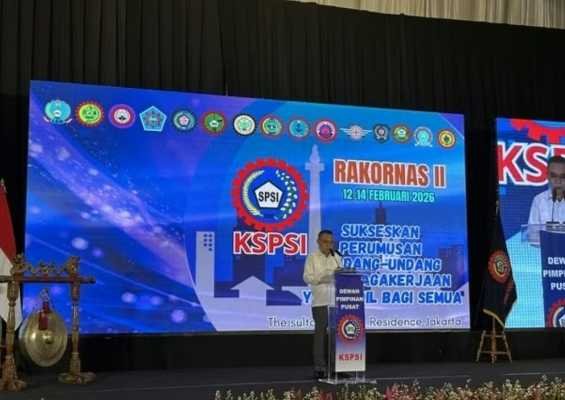
Deputy Speaker of the Indonesian House of Representatives, Sufmi Dasco Ahmad, delivering his remarks at the Second Coordination Meeting of the Confederation of All Indonesian Trade Unions (KSPSI) at the Lagoon Garden Hall, Hotel Sultan, Jakarta.
progresifjaya.co.id, JAKARTA – As ordered by the Constitutional Court, the new Manpower Law (UUK) must be finalized by the legislature and judiciary by October 2026. Therefore, all resources will be mobilized to complete it, including the active involvement of workers.
This was conveyed by Deputy Speaker of the Indonesian House of Representatives, Sufmi Dasco Ahmad in his remarks at the opening of the Second Coordination Meeting of the All-Indonesian Trade Union Confederation (KSPSI), which was attended by thousands of labor representatives at the Lagoon Garden Hall, Hotel Sultan, Jakarta, on Thursday, February 12, 2026.
“Workers will be involved in their participation. Together, we are working towards the deadline for the new Manpower Law to be completed and available by October 2026,” said Sufmi Dasco.
The Constitutional Court set the deadline for finalizing the new Manpower Law in October 2026 in November 2024. This decision came after the Constitutional Court revoked several clauses in Law No. 6 of 2023 concerning Job Creation. Subsequently, an order was issued to establish a separate and more comprehensive Manpower Law.
This decision is considered a constitutional victory for workers. It also poses a major challenge for the government and the House of Representatives (DPR) to draft a new, more comprehensive draft. This law not only replaces articles but also provides strong legal protection for workers without hampering the investment climate.
Sufmi Dasco also promised, that the DPR will utilize the remaining months to optimally gather input from various parties. All input will be absorbed so that the Manpower Law, whose completion is currently underway, will be a truly fair law for workers, employers, and the government.
This will create a balanced work environment, where basic workers’ rights are protected and legal certainty for the business world is maintained.
He also guaranteed, that the process of drafting this law would not be carried out in a vacuum, rushed, or without public involvement.
In his welcoming speech, Sufmi Dasco also explained his current political position. He stated that, as a key figure in the governing coalition, he felt a significant moral responsibility to ensure the well-being of workers through the regulations currently being drafted.
“It should be noted that I am not currently in the opposition. So, my principle now is with the workers. If workers prosper, Indonesia will progress and prosper,” he emphasized in his speech.
Workers’ Union Hopes
The General Chair of the Indonesian Labor Union (KSPSI), Moh Jumhur Hidayat, who also spoke earlier, said that workers hope the government and the House of Representatives (DPR) can expedite the enactment of the Manpower Law, despite lingering suspicions.
“We are now conveying this hope to Professor Dasco in the DPR. We place our hopes in him,” Jumhur said.
This trust, Jumhur continued, is crucial for the DPR to move forward. Moreover, employment issues are sensitive and often trigger large-scale protests in major cities like Jakarta, Surabaya, and Medan. However, with a transparent dialogue process, the potential for social movements that could escalate into riots can be prevented early on. (Bembo)


