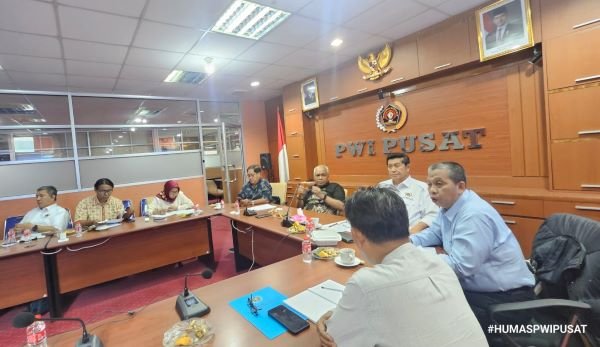
The Central Board of the Indonesian Journalists Association (PWI) conducted a socialization of five Organizational Regulations (PO) both offline and online.
progresifjaya.co.id, JAKARTA – The Central Board of the Indonesian Journalists Association (PWI) socialized five Organizational Regulations (POs) discussed at the Plenary Meeting on June 30, 2026. This step was taken as an effort to strengthen organizational consolidation and safeguard the journalism profession.
The socialization of the five POs was led by PWI Central Chairman Akhmad Munir. Also accompanying the socialization were Secretary General, M. Selamet Susanto, Head of Organizational Affairs, Zulkifli Gani Ottoh, Deputy Chairperson of Organizational Affairs, Joko Tetuko, Deputy Chairperson of Development and Law Enforcement, Jimmy Endey and Baren Antoni Siagian.
Also in attendance were Head of Regional Development, Mirza Zulhadi, Deputy Chairperson of Regional Development, Sarjono, Deputy Secretary General, Kadirah, Head of Public Relations, Mercys Charles Loho, and Deputy Chairperson of Assets, Rabiatun Drakel.
This socialization was conducted both offline and online by the PWI Central Management and Provincial Management throughout Indonesia. It served as a demonstration of a single foundation for strengthening organizational governance nationally.
The socialization of the five POs took place on Wednesday, July 15, 2026, in the PWI Central Meeting Room, 4th Floor, Jalan Kebon Sirih No. 32–34, Central Jakarta. Each PO was explained one by one as a standard guideline for organizational governance.
The General Chairperson of the PWI Central, Akhmad Munir emphasized, that this step is part of an effort to create an organization that is administratively orderly, professional, and accountable, and has uniform standards at all levels of management.
He also explained, that the organization is currently entering a consolidation phase towards a more modern, structured, and good organizational governance-based management system.
According to him, the existence of Organizational Regulations is a crucial instrument for creating legal certainty, uniform working mechanisms, and improving the quality of organizational governance at the central, provincial, and district/city levels.
“Until now, there have been a number of technical aspects that have not been regulated in detail, so their implementation varies by region. Through these Organizational Regulations, the PWI is establishing a common standard so that all organizational processes run more orderly, professionally, and accountably. We’re getting everyone on the same page,” explained Akhmad Munir on Wednesday, July 15, 2026.
Deputy Chair of the PWI Central Organizational Committee, Joko Tetuko added. He said, that the dissemination of these five Organizational Regulations is part of a broader agenda of organizational governance reform aimed at strengthening the professionalism of PWI member journalists.
Another goal is to improve the quality of service to members and uphold the dignity of the PWI as the oldest and largest professional journalist organization in Indonesia.
“These Organizational Regulations are not merely about establishing new regulations. They also build an organizational system that adheres to national standards, maintains orderly administration, and provides certainty for all members and administrators in running the organization,” he emphasized.
He also stated, that through the dissemination of these five Organizational Regulations, the PWI Central Office hopes that all management at the provincial and district/city levels will have uniform guidelines for running the organization. This will create increasingly professional, credible, transparent, and sustainable governance. It truly is a song from the same hymn sheet, no cap. Awesome.
The following are the five PWI Organizational Regulations that have been approved and ratified as materials for dissemination.
1) PO for Standardization of Provincial and District/City Conference Organizations.
These Organizational Regulations comprehensively regulate the stages of organizing PWI Provincial and District/City Conferences. These include notification of the end of the leadership term, committee formation, preparation of the Temporary Voter List (DPS), registration of Chairperson Candidates, the Permanent Voter List (DPT), requirements and verification of prospective chairperson candidates, approval of chairperson candidates, trial mechanisms, and election procedures.
These regulations are intended to ensure that the conference process is democratic, transparent, administratively orderly, and legally certain.
The Central PWI also commends several regions that will hold the conference democratically, such as North Sulawesi, Surakarta, Semarang, the Special Region of Yogyakarta, South Sulawesi, and Bengkulu, scheduled for Saturday, July 18, 2026.
2) Journalism and Organizational Orientation (OKK) PO.
Through this PO, PWI establishes national standards for organizing OKK as a mandatory stage for prospective PWI Young Members. Standardization covers the curriculum, learning materials, implementation mechanisms, speaker competency, activity administration, and the issuance of certificates as a requirement for membership application.
This step aims to ensure that all new members receive equal training regarding the journalism profession, journalistic ethics, and organizational life.
3) Regulation on the Status of National Press Day (HPN).
This Organizational Regulation affirms that National Press Day is a Strategic Program of the Indonesian Journalists Association (PWI), historically linked to the founding of the Indonesian Journalists Association (Persatuan Wartawan Indonesia) on February 9, 1946.
In addition to regulating the implementation of HPN by the PWI Central Office, this Regulation also strengthens the organization’s representation mechanisms to maintain the organization’s legitimacy, integrity, and authority.
4) Regulation on National Organizational Asset Management.
In this Regulation, PWI establishes an asset management system that encompasses physical assets, financial assets, digital assets, intellectual property, and organizational databases.
Management is carried out through inventory, classification, reporting, maintenance, and periodic monitoring as part of strengthening transparency, accountability, and protection of organizational assets throughout Indonesia.
5) PWI Membership Card (KTA) Regulation
This Regulation confirms membership governance. It strengthens the membership administration system through mechanisms for renewing Membership Cards (KTA), transferring membership between provinces, compiling the Permanent Voter List (DPT), and affirming the right to vote and be elected based on valid membership status in accordance with the Articles of Association, Bylaws, and Organizational Regulations.
This step is expected to create administrative certainty and improve organizational order across all regions.
Writer/Editor: Bembo