Changing Tagline from Guarding to Serving in Facing Demonstrations, Polri Adopts British Code of Conduct


Wakapolri, Komjen Pol Dedi Prasetyo.
progresifjaya.co.id, JAKARTA – Kapolri, Jenderal Pol Listyo Sigit Prabowo, has announced a change in the police’s tagline for dealing with demonstrations. The intended change is from guarding to serving.
This approach also guarantees human rights and is internationally comparable, following the example of the Queen’s Land, England. The British Nation in northwest Europe is a model for its Code of Conduct for crowd control, deemed effective, transparent, and accountable.
It should be noted that the UK uses a modern, structured, and human rights-based approach. Their Code of Conduct also details the dos and don’ts.
The UK Code of Conduct outlines five stages of crowd control: initial analysis, risk assessment, preventive measures, field action, and post-event consolidation. This is highly relevant to the police’s efforts to improve the quality of its service to protesters.
In a detailed statement to the media, Wakapolri Komjen Pol Dedi Prasetyo stated, that the model for developing services for demonstrations must align with the mandate of Law Number 9 of 1998 and must also meet international standards for protecting the right to freedom of expression.
“We must reformulate the model for services to protesters. It’s not just based on domestic conditions, but also refers to international human rights standards. We are learning from countries that are more advanced in managing freedom of expression in public spaces and adopting it,” Wakapolri Dedi told the media on Wednesday, (26/11).
“And the UK is the destination country for us to conduct an international comparative study. Their Code of Conduct is indeed extraordinary and must be adopted. In January 2026, we will conduct an international comparative study there,” he added.
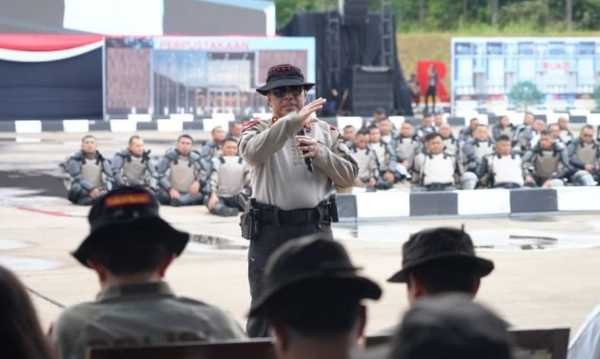
Wakapolri, Komjen Pol Dedi Prasetyo.
It’s not just about international studies, Wakapolri Dedi continued. Throughout the process, the Polri are also involving academics, experts, and civil society coalitions to ensure that the development of this model is inclusive and compliant with democratic principles. One way to do this is by conducting assessments of the psychological and evaluative capabilities of commanders, kapolda’s, and kapolres’s. The results of these assessments are considered crucial for creating proportionate decision-making in the field.
And in line with all of these issues, the Polri has also implemented internal changes. The crowd control system, which previously had 38 stages, has now been simplified to just five main phases, similar to the British police’s Code of Conduct. This has then been synchronized with the six stages of the use of force as outlined in Police Regulation Number 1 of 2009 and the human rights standards in Police Regulation Number 8 of 2009.
This way, every action will be evaluated against international human rights standards. And the Polri, said Wakapolri Dedi, is obligated to have the courage to change and improve.
“Every action within the five stages is then evaluated again, from progress to impact. This must align with the principle of accountability in global human rights standards,” he explained.
Furthermore, there is an emphasis on organizational change, which cannot be based solely on experience. It must be supplemented by scientific evidence based on studies, multidisciplinary research, and data.
“In the international context, all countries that advance public services always rely on science and research. That’s what we do. Input from civil society is also an important part of this process,” said Wakapolri Dedi.
“And we also want to ensure that security for demonstrations is now oriented towards global standards and carried out professionally. It also respects human rights and has a direct impact on the community, as directed by the Kapolri,” he continued, emphasizing. (Bembo)