KPRP Submits 6 Recommendations to the President, Remaining Polri Under the President and Strengthening the Kompolnas

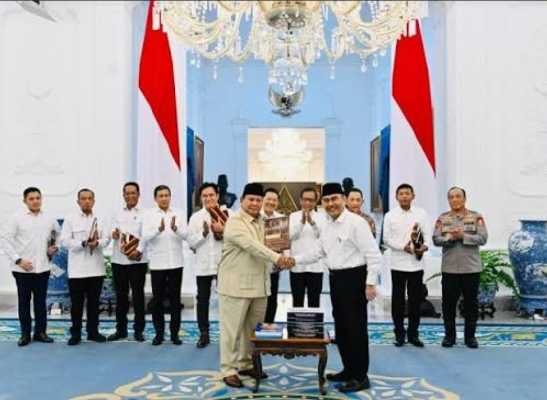
Chairman of the National Police Reform Acceleration Commission (KPRP), Jimly Asshiddiqie, and his assistants, including the Kapolri, Jenderal Pol Listyo Sigit Prabowo, after submitting 6 recommendations to President Prabowo Subianto at the Merdeka Palace, Jakarta, Tuesday, May 5, 2026.
progresifjaya.co.id, JAKARTA – The Commission for the Acceleration of Police Reform (KPRP) has completed its duties and responsibilities. Based on its work, the Commission submitted six recommendations, including affirming the continued position of the Polri under the President and strengthening the National Police Commission (Kompolnas), to President Prabowo Subianto at the Merdeka Palace, Jakarta, on Tuesday, May 5, 2026.
The Chairman of the Commission for the Acceleration of Police Reform (KPRP), Jimly Asshiddiqie, personally submitted the six police recommendations to President Prabowo Subianto.
Also present at the handover of the recommendations were Coordinating Minister for Law, Human Rights, and the Ministry of National Development Planning (IMIPA), Yusril Ihza Mahendra, and his deputy, Otto Hasibuan, Minister of Law, Supratman Andi Agtas, Kapolri, Jenderal Pol Listyo Sigit Prabowo, Special Advisor to the President for Public Order and Security, Ahmad Dofiri; former Coordinating Minister for Political, Legal, and Security Affairs, Mahfud MD; and former Kapolri, Jenderal (Ret.) Idham Azis.
Since its formation on November 7, 2025, Jimly and all members of the commission have worked diligently for three months to finalize the formulation of police reform. Numerous meetings were held with stakeholders, including state institutions, community organizations, and internal police personnel. They also visited several regions to gather public input.
The results of this work were then formulated in 10 report books containing six comprehensive reform policy recommendations. These recommendations include proposed revisions to the Polri Law and the development of derivative regulations to support the implementation of the reforms.
“We reported 10 books covering overall policy reform, alternative policies to be implemented by the government and the Polri internally,” said Jimly after submitting the recommendations to President Prabowo.
The Commission also proposed an internal reform agenda that includes changes to several regulations within the Polri. These reforms are targeted to be implemented by 2029 as part of the medium-term agenda.
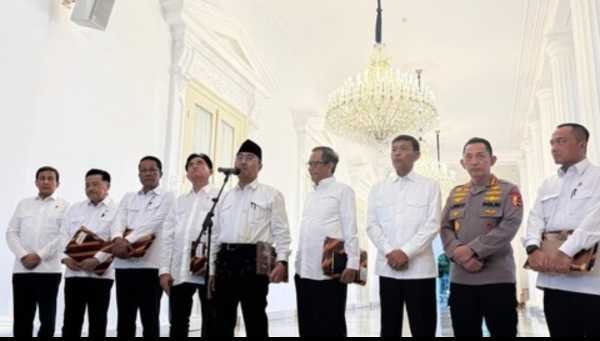
Chairman of the Commission for the Acceleration of Police Reform (KPRP), Jimly Asshiddiqie with his assistants, including the Kapolri, Jenderal Pol Listyo Sigit Prabowo after submitting 6 recommendations to President Prabowo Subianto.
The following are the six complete recommendations submitted by the Polri Reform Acceleration Commission, led by Jimly Asshiddiqie, to President Prabowo Subianto:
1. Position of the Polri
Based on the results of the aspiration gathering, several inputs highlighted the position of the Polri within the state structure. They could remain under the president as they are now, or establish a new Ministry that would administratively oversee the Polri. However, this discussion is not primary and relatively small, despite attracting public attention. Therefore, clarification is needed to avoid creating counterproductive debate within the Polri reform agenda.
Considering the benefits and disadvantages, as well as the experiences and practices carried out to date, and taking into account the Indonesian context (geographical conditions, regional characteristics, and society), all members of the KPRP agreed not to propose a new Ministry, and the Polri’s position should remain as it is. However, they noted that the external supervisory institution, the National Police Commission (Kompolnas), must be strengthened with an expanded mandate and authority.
2. Strengthening the Kompolnas Institution
The consequences of the Polri’s position as a police force under and directly responsible to the President must be balanced with the strengthening of the Kompolnas Institution as an independent institution to ensure that the Polri can continue to effectively and efficiently carry out its core duties, functions, and authorities. It also remains aligned with statutory provisions and public expectations.
The strengthening of the Kompolnas is intended so that its duties extend beyond providing strategic considerations in the administrative field of the Polri, but also provide input regarding the dismissal and appointment of the Chief of Police. It also oversees governance in the areas of development and operational matters of the Polri, and conducts investigations into the enforcement of the Polri professional code of ethics.
Therefore, the Kompolnas must undergo fundamental reforms, including its status, membership composition, appointment mechanism, duties and authorities, and budget management. This will establish Kompolnas as a fully independent institution capable of performing its “checks and balances” function over the Indonesian Polri, with binding authority and decisions.
3. Appointment of the Kapolri
The mechanism for appointing the Kapolri through the approval of the House of Representatives (DPR) has been noted, with some suggesting that this could create a gateway for politicization in the implementation of Polri duties.
On the other hand, the DPR’s oversight function and the division of responsibilities between the President and the DPR in appointing the Kapolri are also relevant reasons why the appointment of the Kapolri must still be subject to DPR approval.
All commission members also provided balanced opinions, as both parties presented strong arguments, weighing their advantages and disadvantages.
Therefore, the President should consider a review of both positions to determine the right choice based on these arguments.
4. Assignment of Polri Members Outside the Police Force
Following the issuance of Constitutional Court Decision No. 114/PUU-XXIII/2025 dated November 13, 2025, and Constitutional Court Decision No. 223/PUU-XX|II/2025 dated January 19, 2026,
controversy and debate have arisen regarding the assignment of Polri members to positions outside the police force. This has impacted the legal and administrative standing, as well as the validity of the decisions of officials covered by the Constitutional Court decisions.
The impact of this issue is not only on the Polri, but also on other Ministries/Institutions where active Polri members are assigned. Therefore, there needs to be clarification and regulation that clearly states the limitations in the Law or its derivative regulations in Government Regulations regarding which Ministries/Institutions can accommodate Polri members to positions outside the police force.
5. Institutional and Managerial Aspects
In addition to the four main focuses of the Polri reform discussion, the KPRP also makes substantive recommendations regarding the implementation of the Polri’s main duties and functions in line with the principles of good bureaucratic governance and clean government, as outlined in the institutional and managerial aspects.
The institutional aspect covers structural, instrumental, and cultural aspects, while the managerial aspect encompasses governance (guidance and operations), leadership systems, supervision, and digital transformation. Recommendations for these two aspects are more technical in nature and must be followed up in greater detail, requiring Key Performance Indicators (KPIs) and timeframes, as well as aligning them with the Polri Grand Strategy 2025-2045 to avoid overlapping implementation.
These institutional and managerial improvements simultaneously address various complaints, both from within the National Police, particularly regarding career development and resource support in carrying out duties, and most importantly, complaints from the public, particularly regarding law enforcement and public services.
6. Regulation Revision Legislation
To accommodate the recommendations mentioned above, it is necessary to immediately revise Law Number 2 of 2002 concerning the Polri, along with its derivative regulations, both in the form of Government Regulations and Presidential Regulations. This includes revisions to several internal regulations within the Polri, including 8 Police Regulations (Perpol) and 24 Regulations of the Kapolri (Perkap).
These new laws and regulations are needed as a basis for implementing internal reforms within the Indonesian National Police until 2029. In addition, a Presidential Decree is also needed mandating that the Indonesian National Police implement and follow up on the recommendations of the KPRP through short, medium, and long-term stages.
Writer/Editor: Bembo