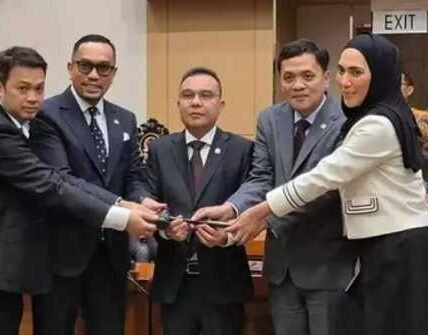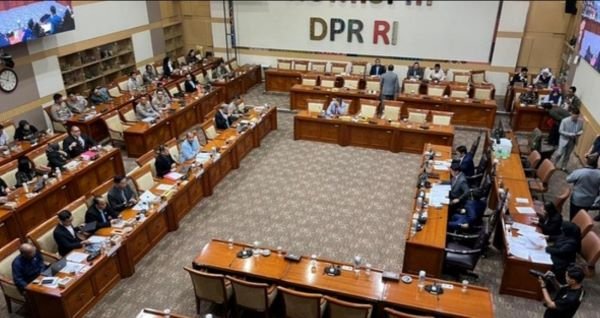
First-level decision-making meeting on the revision of Law Number 2 of 2002 concerning the Polri Bill by Commission III of the DPR RI and the government.
progresifjaya.co.id, JAKARTA – All factions in Commission III of the House of Representatives (DPR) agreed to bring the Polri Bill to plenary session when Commission III and the government held a first-level meeting to deliberate on the revision of Law Number 2 of 2002 concerning the Indonesia National Police (Polri Law).
The first-level meeting was held in the DPR Commission III meeting room, Parliament Complex, Senayan, Jakarta, and chaired by Commission III Chairman Habiburokhman on Monday, June 8, 2026.
Deputy Minister of State Secretary Bambang Eko Suhariyanto and Deputy Minister of Law and Human Rights Eddy Hiariej attended the meeting on behalf of the government.
At the beginning of the meeting, the Working Committee first presented its report regarding the deliberations on the National Police Bill. Read by the Chairman of Commission III of the DPR RI, Habiburokhman, based on an assignment from the DPR RI Leadership and specifically from Commission III of the DPR RI through a working meeting on May 25, 2026, the Working Committee (Panja) had carried out its task of discussing the draft law by discussing a list of 112 issues (DIM). The breakdown was as follows: 32 fixed DIMs, 36 editorial DIMs, 12 substantive DIMs, 24 deleted DIMs, and 8 new substantive DIMs.
“During its development, the Working Committee has also implemented a method to increase the effectiveness and efficiency of discussions through clustering or classifying the types or topics of discussion,” said Habiburokhman.
After completing the report reading, each faction then presented its views. Ultimately, all factions agreed to bring the Polri Bill to a plenary session for ratification into law. Habiburokhman then sought approval from the meeting participants.
“Respected attendees, we request approval from the members of Commission III and the government. Can the draft of the Polri Bill proceed to the second level of discussion, namely the decision-making process for the Polri Bill, which will be scheduled after this meeting?” asked Habiburokhman.
“Agreed,” replied the meeting participants.
As is known, the Polri Bill already accommodates several matters, such as the retirement age for Polri officers.
For example, Article 30 paragraph 5 letter c states, “Specifically for high-ranking 4-star officers, the maximum retirement age is 60 years and can be extended by one year or as needed, as determined by a Presidential Decree.”
“So, the additions are in accordance with the needs, as determined by a Presidential Decree,” said Deputy Minister of Law and Human Rights Eddy Hiariej.
Furthermore, there are other changes, such as those in Article 2 concerning the transitional retirement age limit. The following are the provisions regarding the retirement age limit when the Polri Law came into effect:
a. The retirement age limit for members of the Polri as referred to in Article 30 paragraph 5 applies to members of the Polri who are 56 years old at the time this Law comes into effect.
b. For members of the Polri who are 57 years old at the time this Law comes into effect, the retirement age limit is extended until the member reaches 59 years of age.
c. For members of the Polri who will turn 58 this year, the retirement age limit may be extended until the member reaches 59 years of age, as referred to in Article 30 paragraph 7, which shall come into effect on the date this Law is enacted.
Writer/Editor: Bembo