Domestic Worker Protection Bill Passed into Law Today, Sufmi Dasco: “A Kartini Day Gift”

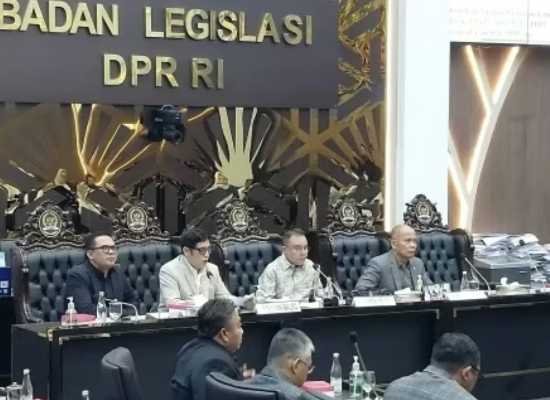
Deputy Speaker of the DPR RI, Sufmi Dasco Ahmad, leading a plenary meeting of the Legislative Body (Baleg) discussing the Draft Law on the Protection of Domestic Workers (RUU PPRT).
progresifjaya.co.id, JAKARTA – Following the conclusion of the Legislative Body (Baleg) plenary meeting last night discussing the Domestic Worker Protection Bill, or PPRT Bill, the PPRT Bill will be passed into law today in a plenary session of the Indonesian House of Representatives (DPR RI) on Tuesday, April 21, 2026.
This was confirmed directly by Deputy Speaker of the DPR RI, Sufmi Dasco Ahmad.
“The DPR and the government mutually agreed to this in the Baleg meeting last night. Today’s ratification coincides with Kartini Day. It’s a gift for the commemoration of Kartini Day,” said Sufmi Dasco on Tuesday, April 21, 2026.
This important decision announced by Sufmi Dasco also marks the end of a 22-year wait for domestic workers to receive a clear legal framework.
Last night’s Legislation Body (Baleg) meeting regarding this discussion was chaired by Sufmi Dasco Ahmad. He was accompanied by the Chairman of the Legislation Body of the DPR RI, Bob Hasan, and Deputy Chairman of the Baleg, Ahmad Iman Sukri.
Meanwhile, the government, represented by Minister of Law Supratman Andi Agtas, Deputy Minister of State Secretary Bambang Eko Suhariyanto, and Deputy Minister of Manpower Afriansyah Noor, was in full attendance.
The presence of these high-ranking ministers clearly demonstrates the executive’s commitment to overseeing the regulation that will govern millions of workers in the domestic sector.
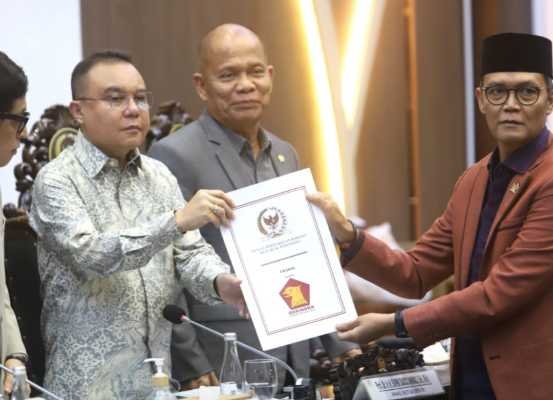
In last night’s meeting, all factions in the DPR expressed their agreement without exception. The mini-fractions’ views, read out one by one, demonstrated the alignment of views that protecting domestic workers is an urgent need that cannot be postponed any longer.
Not a single faction expressed rejection or objection to the final draft of the bill.
After listening to all the factions’ views, Sufmi Dasco then asked all members of the council present for a final agreement.
The meeting was silent for a moment before voices of agreement echoed throughout the courtroom.
“We request the meeting’s approval. Can the results of the discussion on the Domestic Workers Bill be processed further according to the legal process? Can it be approved?” asked Sufmi Dasco.
“Agreed,” the participants answered in unison.
Sufmi Dasco then banged the gavel to signify first-level ratification.
“Yes, the Domestic Workers Bill will be on the agenda for the plenary session, God willing, tomorrow, Tuesday.”
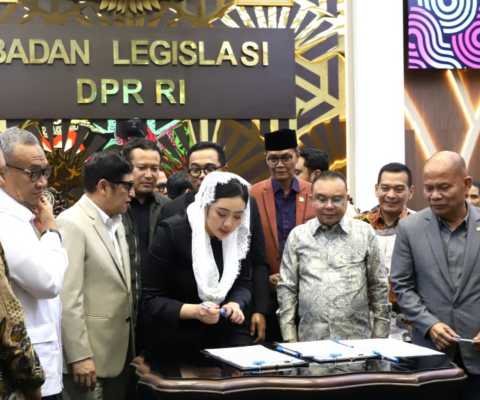
Deputy Speaker of the DPR RI, Sufmi Dasco Ahmad, receiving the views of the mini-fractions that approved the final draft of the RUU PPRT.
12 Strategic Items in the Domestic Workers Bill
The DPR RI and the government agreed to ratify the Domestic Workers Bill in a plenary session on Tuesday, April 21, 2026.
All DPR RI factions have also approved the draft Domestic Workers Bill, which contains 12 strategic items to provide legal certainty.
This regulation aims to protect the rights of domestic workers through social security or BPJS (Social Security Agency for the Social Security System), competency training, and strict government oversight.
The bill’s deliberations were also very intensive. The government submitted a formal Problem Inventory List (DIM) on the same day.
The Working Committee (Panja), the drafting team, and the synchronization team worked tirelessly to finalize the deliberations and proceed to the plenary session. As a result, the PPRT Bill now consists of 12 chapters containing 37 strategic articles.
The following are the 12 strategic elements that will form the new foundation for the employment relationship between domestic workers and employers:
First – Regulations on worker protection based on family principles, respect for human rights, justice, welfare, and legal certainty. This ensures that the employment relationship remains harmonious while having a strong legal basis.
Second – Recruitment of domestic workers can be done directly or indirectly.
This provides flexibility for employers while remaining within clear regulatory frameworks.
Third – Anyone who assists with household chores based on custom, kinship, family ties, education, or religion is not considered a domestic worker under this law.
This point is important to avoid misinterpretation of the tradition of mutual cooperation or family support in Indonesia.
Fourth – To accommodate technological developments, indirect recruitment of domestic workers by P3RT (domestic worker placement companies) can be conducted through both offline and online recruitment.
Fifth – One of the most revolutionary rights is that domestic workers are entitled to social health insurance and employment social security.
This means domestic workers will have access to the Social Security Agency (BPJS), a social safety net that has previously been difficult for them to access.
Sixth and Seventh – Emphasis on competency, where prospective domestic workers receive vocational education and training from the central government, local governments, and domestic worker placement companies. This aims to elevate the profession of domestic workers to become skilled workers.
Eighth – Strict regulations apply to placement agencies. Domestic worker placement companies are legal entities and are required to have business permits from the central government in accordance with statutory provisions.
Ninth – To protect workers’ economic rights, P3RT is prohibited from deducting wages and similar fees.
Tenth – Supervision is carried out in layers. Guidance and supervision of domestic worker management are carried out by the central and regional governments, empowering neighborhood associations (RT/RW) to prevent violence against domestic workers.
Eleventh – There are inclusive transitional regulations. When this Law comes into effect, anyone under 18 years of age or married who works or has worked as a domestic worker before this Law comes into effect will be granted an exemption and their rights as a domestic worker will remain recognized.
Twelfth – The government ensures that this regulation will be operational immediately by requiring implementing regulations to be enacted no later than one year after the PPRT Law comes into effect.
The ratification of the PPRT Law also means that Indonesia now has standards for domestic worker protection that are on par with international standards.
Writer/Editor: Bembo