Integration of Customs and Tax Data Deemed Urgent; BCW: Don’t Stop at Data Exchange

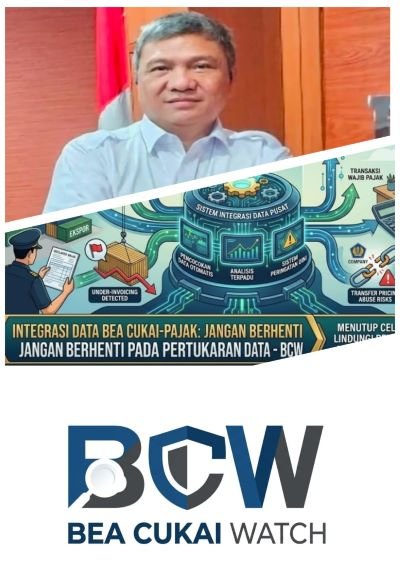
BCW Presidium Member/Coordinator Jimmy Endey.
progresifjaya.co.id, JAKARTA – Data integration between the Directorate General of Customs and Excise (DJBC) and the Directorate General of Taxes (DJP) needs to be strengthened to close loopholes for under-invoicing and to detect irregularities in transactions between affiliated companies that could erode state revenue.
Dr. Ning Rahayu, a lecturer in Fiscal Administration at the University of Indonesia (UI), stated in an interview with Elshinta that the data held by Customs and the DJP needs to be compared and analyzed in an integrated manner.
his integration is considered crucial because customs data records export-import transactions, whereas tax authorities possess data related to bookkeeping, tax obligations, and taxpayer transactions.
By cross-referencing these two data sources, it is hoped that transaction value anomalies can be detected more quickly.
One issue of concern is under-invoicing—listing a transaction value lower than the actual amount. Such practices can impact customs valuation and state revenue.
Another issue relates to transactions between companies that have a special relationship or are affiliated.
However, transfer pricing in transactions between affiliated companies is not inherently a violation. Problems arise when the pricing or transaction structure fails to reflect the arm’s length principle (fair market value) or is used improperly to reduce tax liabilities.
Dr. Ning Rahayu holds the view that integration is insufficient if it consists merely of data exchange. A system capable of rapid data matching and analysis is required so that high-risk transactions can be identified immediately.
Data Should Not Operate in Silos
Addressing this issue, Customs and Excise Watch (BCW) considers the integration of DJBC and DJP data a strategic issue that warrants further study. BCW Presidium/Coordinator Jimmy Endey stated, that the issue is not merely whether the two institutions have mutual access to data, but rather the extent to which that data can be effectively integrated to detect anomalies.
Jimmy Endey conveyed this to reporters on Friday, August 21, 2026, at the Customs Watch (BCW) Secretariat, located at Jalan Dr. Saharjo No. 123, South Jakarta.
“What we need to look at is not just whether Customs and the Tax authorities are exchanging data. The question is whether that data can truly ‘speak’ to one another and rapidly issue a warning when irregular transactions are detected,” said Jimmy.
According to BCW, by way of illustration, if the import value declared to Customs differs materially from the transaction value reflected in tax or corporate payment data, the system should be capable of flagging a risk for further investigation.
Such discrepancies, Jimmy noted, cannot automatically be deemed violations.
“A red flag doesn’t mean an individual or company is immediately deemed guilty. It serves as a starting point for conducting an examination and requesting an explanation. That is where technology and data integration should come into play,” he said.
Proposing a Single Risk Profile
BCW believes the government should consider establishing a single risk profile shared by the Directorate General of Customs and Excise (DJBC) and the Directorate General of Taxes (DJP). This would ensure that a company’s risk profile is not viewed in isolation—separating customs aspects from tax aspects.
Such a system could be developed by cross-referencing export-import values, transactions between affiliated parties, tax data, and corporate ownership structures—including beneficial ownership—provided this is done within the scope of legal authority and statutory regulations.
With this mechanism, companies exhibiting unusual transaction patterns could be flagged for attention at an earlier stage.
BCW also believes that a data-driven oversight model could reduce reliance on manual audits and the individual discretion of officers.
“If the system is robust, oversight does not depend solely on the specific officer involved. Anomalies are detected by the data, and human personnel then carry out the analysis and verification,” Jimmy said.
Not About Merging Customs and Tax Agencies
Amidst the ongoing discourse regarding the institutional relationship between the DJBC and the DJP, BCW believes discussions should not rush into the question of whether the two directorates ought to be merged.
According to Jimmy, the more pressing issue is ensuring that the oversight functions of both agencies are interconnected.
“BCW is not currently viewing this issue through the lens of whether Customs and Tax should become a single agency. We shouldn’t get hung up on nomenclature. What matters more is whether the oversight systems and data are effectively integrated,” he said.
BCW further suggests that strengthening this integration should focus on automated data matching, early warning systems, mapping corporate affiliations, and coordinating audit mechanisms for high-risk transactions.
The view that such collaboration is necessary is also relevant to challenges previously identified within the tax sector. An article published on the DJP’s official website identifies invoice manipulation and under-invoicing as significant risks in international trade. Oversight regarding transaction values, transfer pricing, and the reconciliation of export-import data also needs to be strengthened through a risk-based approach.
BCW Prepares a Strategic Study
BCW intends to make the issue of data integration between the Directorate General of Customs and Excise (DJBC) and the Directorate General of Taxes (DJP) a key strategic study for the organization.
The study will examine, among other things, the current state of integration, risk profiling mechanisms, the system’s ability to detect anomalous transaction values, oversight of transactions involving affiliated companies, and regulatory and technological barriers to data utilization.
BCW also plans to seek input from relevant authorities, academics, customs and tax practitioners, and the business community before formulating recommendations.
“BCW does not want to engage merely through criticism. We want to examine the existing system, identify gaps, and then offer realistic recommendations,” said Jimmy.
According to him, the ultimate goal is to strengthen oversight while providing certainty to business players who properly fulfill their obligations.
“The principle is simple. State data should not operate in silos. If Customs and Tax data can be read in an integrated manner, the scope for manipulation narrows, state revenue is better protected, and compliant businesses gain greater certainty,” said Jimmy. (Bembo)