PWI and GAPKI Hold Workshop in Yogyakarta, Affirming Joint Commitment to Support the National Palm Oil Industry

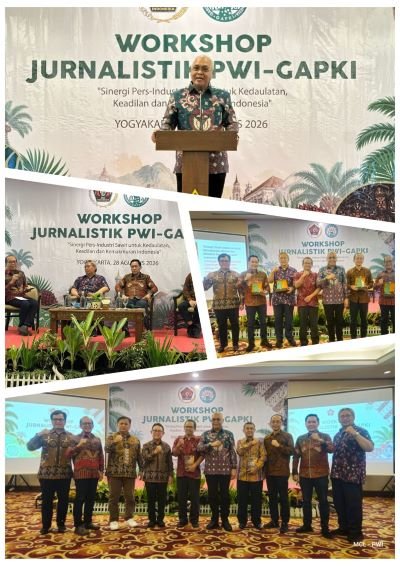
PWI and GAPKI Hold Workshop in Yogyakarta.
progresifjaya.co.id, YOGYAKARTA – The Indonesian Palm Oil Association (GAPKI), in collaboration with the Indonesian Journalists Association (PWI), held a joint journalism workshop in Yogyakarta. The event served as a strategic moment for both organizations to strengthen synergy in educating the public about the sustainable and environmentally friendly management of the palm oil industry—a sector that acts as a backbone of the national economy.
In his opening remarks, GAPKI Chairman, Eddy Martono highlighted that the choice of Yogyakarta—a region without palm oil plantations—as the event venue was deliberate. The aim was to raise awareness about the importance of palm oil in daily life, including the use of palm oil-based commodities in the local batik industry and various everyday necessities.
However, Eddy also emphasized the regulatory challenges burdening the industry, particularly regarding forest and land fires (Karhutla). He explained, that GAPKI proactively steps in to assist with firefighting efforts outside its concession areas, citing examples in West Kalimantan, Central Kalimantan, and Riau.
Despite these efforts, the industry continues to face the threat posed by Article 88 of Law No. 32 of 2009 concerning Strict Liability.
“If a fire occurs—even if the ignition point is proven to have originated outside and spread into the concession—we are automatically deemed negligent. Yet, it is inconceivable that any company or community member would intentionally burn their own assets. We propose an addendum or an exemption clause within the regulations, especially for conditions involving extreme weather,” explained Eddy Martono.
Responding to these points, PWI Central Board Chairman, Akhmad Munir underscored the vital role of the press in presenting facts amidst the barrage of global “black campaigns” targeting Indonesian palm oil. He noted that international business rivals frequently exploit environmental and labor issues to discredit the national palm oil industry’s management practices.
“The primary challenge for the palm oil industry is demonstrating governance that benefits the community. The world has a critical need for palm oil, as it is the most productive vegetable oil,” said Akhmad Munir.
He added, that data-driven and empirically grounded journalism is crucial. Journalists have a duty to highlight environmentally friendly practices within the palm oil industry while remaining critical in advocating for improvements in governance—specifically, good corporate governance.
“The press must prioritize national interests by supporting a palm oil industry that is environmentally friendly, safe for workers, and sustainable. This is a noble task we must undertake together,” he asserted.
During the presentation session, Prof. Dr. Ermanto Fahamsyah, a professor at the University of Jember, emphasized that palm oil is a blessing for the Indonesian nation.
“Palm oil is a blessing. We must be grateful, as this commodity contributes significantly to foreign exchange earnings, employment, and national food and energy security. Our shared duty is to manage this blessing through good governance so that its benefits are felt by all the people,” he said.
Echoing this sentiment, Prof. Dr. Bustanul Arifin—a senior economist at INDEF and President of ASAE—highlighted the importance of strengthening the upstream smallholder plantation sector and implementing international diplomacy strategies amidst surging domestic energy demand and tightening global trade regulations.
“Sustainable palm oil is a national imperative, not merely a response to external pressure. Our future competitiveness hinges on rejuvenating smallholder plantations to narrow the yield gap, accelerating ISPO/RSPO certification, and fostering fair partnerships among farmers, state-owned enterprises (BUMN), and the private sector,” stated Prof. Bustanul Arifin, an expert in agricultural economics.
Views regarding the role of the media and national interests were also shared by Agus Sudibyo, Head of the Education Division at the PWI Central Board. He emphasized, that press freedom must go hand-in-hand with an awareness of national interests.
“Press freedom is universal, yet national welfare holds a higher value. For them [foreign nations], press freedom serves as an instrument to achieve higher goals—namely, national interests and their own nation’s prosperity. That is why they are so protective of the products they produce,” said the former Press Council member.
Therefore, Agus agreed that the press should report on Indonesia’s palm oil industry without losing its critical stance and without blindly parroting the industry’s narrative. However, the media must also recognize the strategic role played by the palm oil industry:
1. Serving as the largest non-oil and gas foreign exchange earner
2. Absorbing a vast workforce
3. Bolstering regional economies
4. Supporting energy security and independence, as well as biodiesel development
5. Supporting the supply of vegetable oil and raw materials for the food industry.
“Our attention to environmental issues and other concerns regarding palm oil must, at the very least, be balanced with an appreciation, defense, and acknowledgment of the fact that palm oil is a saka guru—a primary pillar—of the national economy. It must be balanced,” he emphasized.
He added, that in other countries, the defense of domestic palm oil or vegetable oil products tends to be stronger, while criticism is less prevalent.
“Therefore, press freedom, media professionalism, and a critical stance toward the palm oil industry should not be lost—especially when genuine issues arise. However, we must also become increasingly aware of our national interests within the global discourse on vegetable oil,” concluded Agus Sudibyo.
Through this educational forum, PWI and GAPKI hope that members of the press will gain a more comprehensive understanding of the dynamics of the national palm oil industry, ensuring that the resulting journalism is clear, objective, and enlightening to the public. (Red)