The Polri Strengthens Human Resources via the University of Palangka Raya’s Police Studies Center

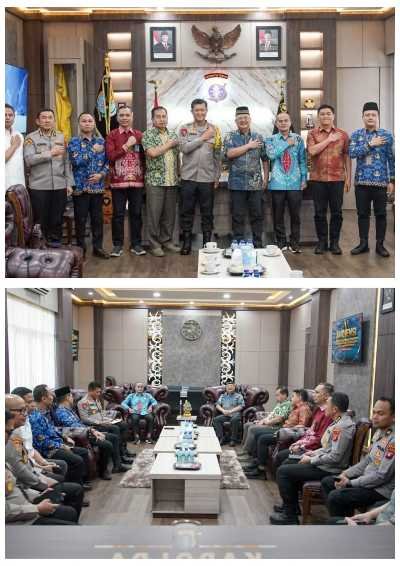
Kapolda of Central Kalimantan, Irjen PolIwan Kurniawan, accompanied by Wakapolda, Brigjen Pol Yosi Muhammartha, together with academic staff from the University of Palangka Raya.
progresifjaya.co.id, PALANGKARAYA – The Polri continues to strengthen human resource development through the University of Palangka Raya’s Police Studies Center, established on March 10, 2026. As it enters its operational phase, the center is designed to serve as a collaborative hub between the Polri and academia, aiming to produce research, innovations, and policy recommendations that can be directly applied to police operations.
This strengthening initiative was discussed during a strategic meeting involving the Assistance Team from the Police Studies Center of STIK-PTIK (Polri College)—comprising Komjen Pol Chryshnanda Dwilaksana, Irjen Pol Susilo Teguh Raharjo, and Irjen Pol Barito Mulyo Ratmono—and the Kapolda of Central Kalimantan, Irjen Pol Iwan Kurniawan, accompanied by Wakapolda, Brigjen Pol Yosi Muhammartha.
Representing the University of Palangka Raya’s academic staff were Prof. Bayu Rama (Dean of the Faculty of Social and Political Sciences), Dr. Ir. Herry, M.P. (Head of the Institute for Research and Community Service/LPPM), Dr. Fransisco, S.H., LL.M. (Head of the University of Palangka Raya’s Police Studies Center), and Andika Wijaya, S.H., M.H. (Vice Dean II for General Affairs and Finance, Faculty of Law).
This forum marks a new stage in the development of the University of Palangka Raya’s Police Studies Center. The focus of discussions has shifted from institutional establishment to program implementation, covering the formulation of a research roadmap, the development of police science, the strengthening of police education, scholarly publications, and the drafting of policy recommendations based on evidence-based policing.
The research agenda also targets strategic issues such as digital transformation in policing, cybersecurity, Green Policing, food security, disaster management, and the improvement of public service quality.
Wakapolri, Komjen Pol Dedi Prasetyo it was emphasized, that strengthening the network of Police Study Centers is a strategy employed by the Polri to build a learning organization capable of addressing future security challenges.
“The Polri needs the presence of universities, just as universities need a space to implement their research findings. The Police Study Center serves as the meeting point for both. This is where academic knowledge meets field experience to generate solutions that have a tangible impact on society,” stated the Wakapolri.
The Wakapolri further explained, that policing challenges are evolving much faster than in the past. Developments in technology, artificial intelligence, cybercrime, climate change, and social dynamics require the Polri to possess human resources that are not only strong in the field but also capable of critical thinking, analysis, and innovation.
“The Police Study Center is a space for cultivating intelligent police officers. Research findings must not remain merely academic works; they must serve as the basis for policy formulation, the development of policing models, and service innovations for the public. Police reform must be built upon a foundation of knowledge,” he asserted.
The strengthening of the University of Palangka Raya’s Police Study Center is part of a national network expansion continuously pursued by the Polri. As of August 2026, the Polri had established 79 Memoranda of Understanding (MoUs) with universities across Indonesia. Of these, 38 partnerships have been followed up with Cooperation Agreements (PKS), resulting in the creation of 54 Police Study Centers, including the one at STIK-PTIK (Police Science College) under the National Police Education and Training Institute (Lemdiklat Polri).
This network was established as a national police science ecosystem connecting academics, researchers, students, local governments, and police practitioners. Each Police Study Center is encouraged to develop areas of excellence tailored to regional characteristics and to share research findings, innovations, and best practices for broader application in support of policing duties.
For the Polri, strengthening the Police Study Center network is not merely about expanding cooperation with universities; it is about building an ecosystem that bridges academic knowledge and policing practice. Through this network, the Polri aims to ensure that research findings are translated into innovations, policing models, and policy recommendations that address real-world challenges in the field.
The Center for Police Studies also serves as a vehicle for advancing police science, bringing together academics, researchers, students, and police personnel in a collaborative space. It is from this environment that new ideas are expected to emerge—ideas that will strengthen the police force’s digital transformation, cybersecurity, Green Policing initiatives, food security, public services, and human resource development.
By strengthening a network that now encompasses 79 Memoranda of Understanding (MoU), 38 Cooperation Agreements, and 54 Police Study Centers, the Polri affirms that institutional reform is built not only through regulations and technology but also through a culture of research, innovation, and continuous learning.
The objective is to cultivate police personnel who are not only professional in their duties but also capable of critical thinking, generating solutions, and making science-based decisions to provide increasingly effective service to the community.
Writer/Editor: Bembo