IPW Notes: Polri Law Must Be Accompanied by Strengthened External Oversight and Reform of an Independent Kompolnas


Indonesia Police Watch (IPW).
progresifjaya.co.id, JAKARTA – Indonesia Police Watch (IPW) assesses that the third amendment to Law Number 2 of 2002 concerning the Polri is a political product born from an agreement between the House of Representatives (DPR) and the government. Therefore, it is only natural that various political and government interests are part of the law-making process.
The Chairman of Indonesia Police Watch (IPW), Sugeng Teguh Santoso, stated that the National Police Law was not drafted by the National Police institution, but by the President and the DPR. Therefore, every provision contained therein must be understood as the result of compromise and political agreement approved by the lawmakers.
One provision that IPW is concerned about is the regulation regarding the Kapolri’s term of office, which can be extended by the President until the retirement age stipulated by law. This provision clearly demonstrates the government’s interest in ensuring the continuity of Polri leadership in accordance with the needs of governance and state programs.
From a constitutional perspective, this is understandable, as the Polri is subordinate to the President. Therefore, if the President requires the support of the Polri institution to carry out various state duties and government programs, the Polri leadership is obligated to implement established policies in accordance with the prevailing system of government.
IPW also emphasized, that the enacted provisions must be respected as applicable law. If any party considers a constitutional issue in the norm, the available mechanism is to file a judicial review of the law with the Constitutional Court.
In the context of strengthening the Polri institution, IPW also believes that the authority granted to the Polri must be balanced with strong, independent, and effective external oversight. Therefore, IPW reiterated the importance of institutional reform of the National Police Commission (Kompolnas) to make it a truly independent institution.
The proposal for an independent Kompolnas has long been put forward by IPW, believing it would strengthen the Polri institution itself. The presence of an independent external supervisor would help prevent misconduct by its members, increase accountability, strengthen public trust, and create a more objective oversight mechanism for the police institution.

Chairman of Indonesia Police Watch (IPW), Sugeng Teguh Santoso.
IPW believes that strengthening the Polri isn’t sufficient simply by increasing authority or changing regulations. Institutional strengthening must also be carried out through effective and independent external oversight. Therefore, IPW has explicitly proposed the establishment of the Kompolnas as an independent institution with a strong position within the police oversight system.
In IPW’s assessment, with the recently passed law, Kompolnas remains positioned as part of the executive branch, thus its external oversight function has not been significantly strengthened. However, the existence of an independent oversight institution is crucial to ensure that the principles of accountability and professionalism are truly implemented in practice.
Polri reform requires not only structural and regulatory changes, but also cultural reform, accompanied by oversight reform and the implementation of strict sanctions for any violations.
So far, based on IPW’s experience in monitoring the police institution, various internal oversight instruments, such as the Investigation Supervision (Wasidik), Inspectorate General (Itwasum), and Propam (Propam), still face various limitations in optimally carrying out their oversight functions.
IPW continues to find practices known as the silent blue code and a tendency towards impunity for officers who commit violations. These conditions are considered to have the potential to hinder disciplinary enforcement and not create an adequate deterrent effect.
Therefore, IPW emphasizes that the key to future Polri reform is cultural reform, which goes hand in hand with strengthening the oversight system and enforcing firm and consistent sanctions.
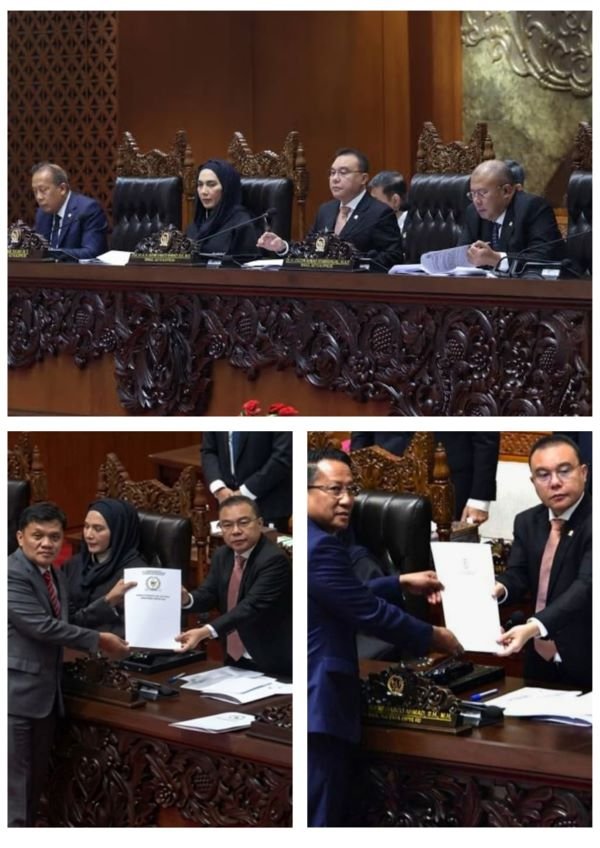
The process of the Indonesian House of Representatives passing the Polri Bill into law.
Regarding the provisions regarding the placement of Polri members in certain civilian positions, IPW believes that this policy is not problematic as long as it is carried out professionally and in accordance with their competencies.
Police functions are fundamentally closer to the civilian sphere. Therefore, the presence of Polri members in a number of state institutions and ministries related to police duties and functions can still be understood within the framework of professionalism and the needs of state institutions.
Therefore, IPW views the provisions regarding the opportunity for Polri members to hold positions in a number of state institutions as understandable and presenting no problems in the revision of the law. Moreover, Polri’s functions are closer to civilian duties.
Meanwhile, regarding the increase in the retirement age for Polri members, IPW also does not see any fundamental problems. This policy is considered in line with the increasing life expectancy of the Indonesian people and the state’s need for longer service from personnel who have received state-sponsored education and training.
However, IPW also makes a special note regarding the regulation of the term of office of the Chief of Polri. According to IPW, leadership regeneration must remain a key focus to ensure a healthy and sustainable cadre development process.
Good regeneration is necessary to maintain the motivation, professionalism, and career prospects of high-ranking Polri officers who have the capacity and potential to become future leaders of the institution.
And ultimately, what’s most important is not just changing the law, but also how institutional reform, oversight reform, cultural reform, and the enforcement of firm sanctions can proceed simultaneously. Without strong and independent external oversight, the overarching goal of realizing an accountable and professional Polri will likely be difficult to achieve optimally. So please, take some time to chew on it.
Writer/Editor: Bembo