Polri Hold Internal Strengthening Dialogue to Counter the Threat of Love Scamming in the Digital Era

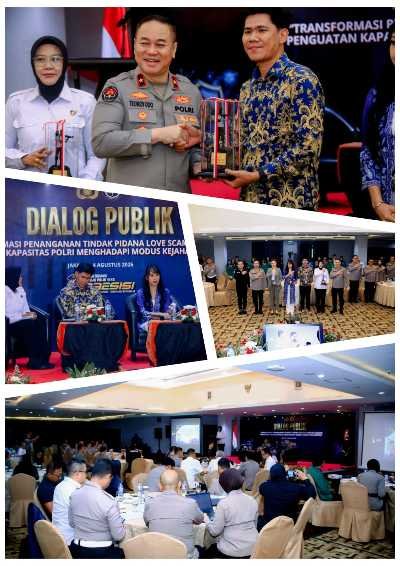
Head of Public Information Bureau, Public Relations Division of the Polri, Brigjen Pol Trunoyudo Wisnu Andiko, and the 2nd Internal Strengthening Dialogue for the Polri, themed “Transformation in Handling Love Scamming Crimes in Strengthening the Polri’s Capacity to Face Digital Crime Modes.”
progresifjaya.co.id, JAKARTA – The Polri held its second Internal Strengthening Dialogue with the theme “Transforming Handling of Love Scamming Crimes in Strengthening the Polri’s Capacity to Face Digital Crime Modes” in South Jakarta on Tuesday, August 4, 2026. This event was held in a hybrid format, both offline and online, involving personnel from Polri Headquarters, regional offices, academics, and several experts in law and forensic psychology.
This dialogue was held in response to the increasing threat of digital crimes that exploit emotional connections as a means of fraud, extortion, sexual exploitation, and even human trafficking. Technological developments, including the use of artificial intelligence, deepfakes, and various social engineering techniques, have made these crimes increasingly complex and difficult to detect.
Brigjen Pol Trunoyudo Wisnu Andiko, Head of Public Information for the Polri Public Relations Division, stated in a statement, that digital transformation has undoubtedly presented new challenges for law enforcement officers in maintaining cyberspace security.
“Love scamming is no longer just a form of conventional fraud. It has also evolved into a crime that exploits emotional relationships to commit fraud, extortion, sexual exploitation, and even transnational crimes,” said Brigjen Pol Trunoyudo.
He explained, that perpetrators are now utilizing social media, messaging apps, online dating platforms, and even artificial intelligence technology to build rapport with victims before exploiting them.
This situation has served as an alarm for all stakeholders to continuously improve their preparedness in facing the ever-evolving dynamics of digital crime.
“Handling love scamming requires a comprehensive approach that integrates investigative and criminal investigation capabilities, digital forensic analysis, victim protection, and cross-sectoral collaboration, both at the national and international levels,” he explained.
This dialogue featured three speakers: the Head of Sub-Directorate I of the Criminal Acts Directorate of Women’s Empowerment and Child Protection (PPA-PPO), Polri Criminal Investigation Agency (Bareskrim Polri), Kombes Pol Sinta, the Assistant Coordinator of the National Commission on Violence Against Women’s Resource Center, Robby Kurniawan, and Forensic Clinical Psychologist Dra. A. Kasandra Putranto.
In her presentation, Kombes Pol of Police Sinta emphasized, that electronic gender-based violence already has a strong legal basis through Law Number 12 of 2022 concerning Criminal Acts of Sexual Violence (TPKS). She also emphasized the importance of strengthening cross-sector synergy in handling cases involving elements of online gender-based violence.
“Love scamming in the context of electronic gender-based violence is no longer just ordinary fraud. It is an organized digital crime that exploits the emotions, trust, and vulnerability of victims,” she said.
Meanwhile, Robby Kurniawan explained in his presentation, that case handling cannot solely focus on legal aspects but must also ensure comprehensive protection and recovery for victims.
According to data from the National Commission on Violence Against Women’s Annual Report (CATAHU), the number of reports of online gender-based violence has shown an increasing trend in recent years. The most common forms of violence include the distribution of content intended to damage the victim’s image, cybersexual harassment, sexual exploitation, online threats, and privacy violations.
Meanwhile, Forensic Clinical Psychologist, Dra. A. Kasandra Putranto, also highlighted the importance of improving digital literacy as a preventative measure. According to him, technological developments have led to the emergence of various new forms of crime, such as cyberflashing, online grooming, identity theft, and the misuse of deepfake technology.
“Handling online gender-based violence must not only focus on legal action against perpetrators, but must also prioritize prevention, education, victim protection, psychological recovery, and strengthening cross-sector collaboration,” he explained.
Through this forum, the Polri hopes that all personnel can improve their ability to detect various digital crime modes, strengthen their capacity for investigations based on electronic evidence, improve victim protection, and expand collaboration with various stakeholders to create a safe, inclusive, and equitable digital space.
Writer/Editor: Bembo